
- Your cart is empty
- Continue shopping
-
Dr Prakul Rakesh
- Posted on
- Categories:Bio Enzyme, Environment, Sustainability
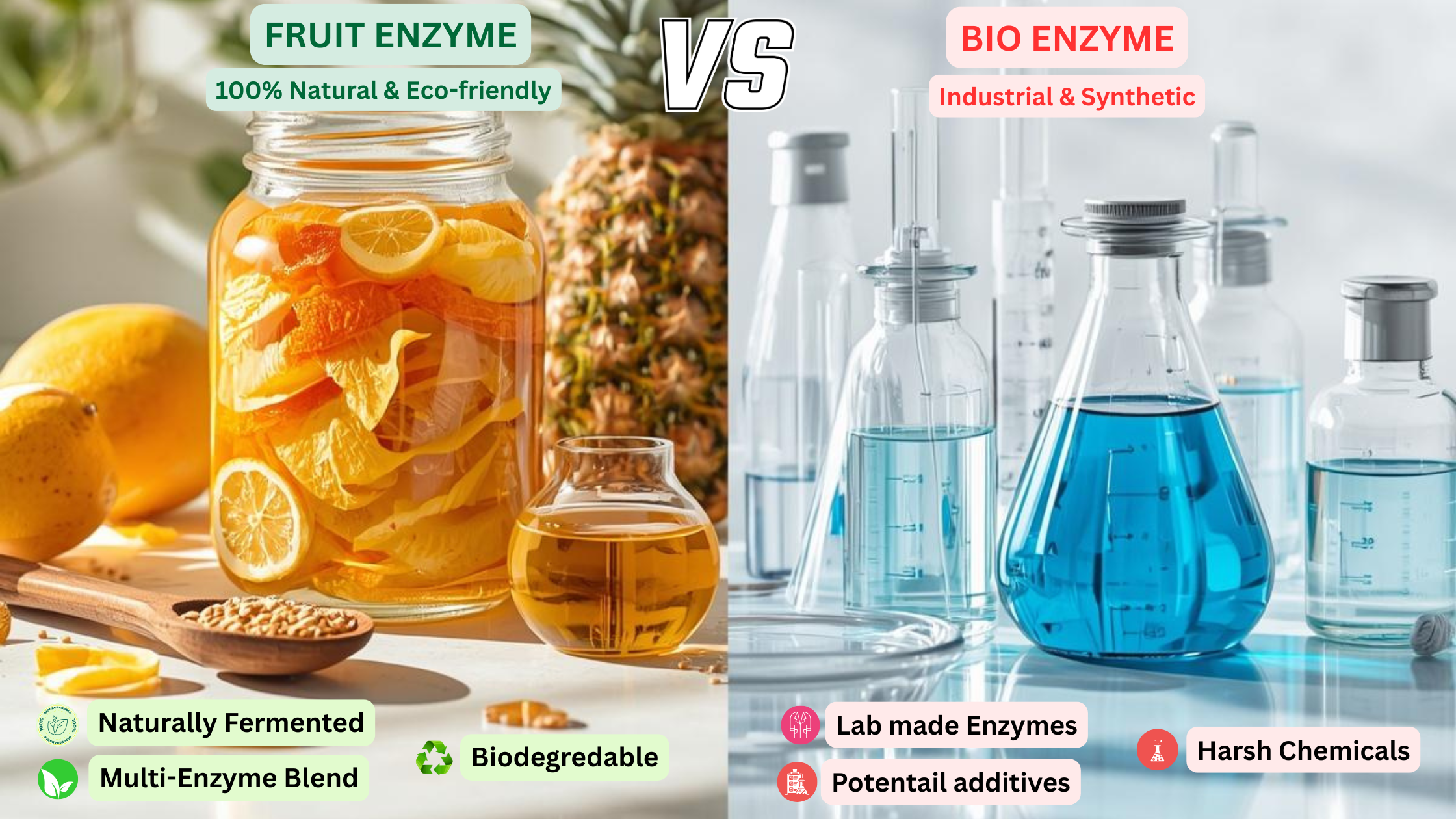
In the growing market of eco-friendly cleaning products, the terms fruit enzyme and bio enzyme are often used interchangeably. While both relate to enzyme-based cleaning, they differ significantly in origin, processing, and overall impact. For consumers seeking a truly natural, safe, and sustainable solution, fruit enzyme cleaners offer a clear advantage. Here is the proper comparison of Fruit Enzyme Vs Bio Enzyme
What is a Fruit Enzyme Cleaner?
A fruit enzyme cleaner is produced through the natural fermentation of fruit peels, jaggery or sugar, and water over a period of time. This process transforms organic waste into a powerful cleaning solution.
Key Characteristics:
- Derived from natural fruit waste
- Produced through slow fermentation
- Contains a blend of naturally occurring enzymes
- Includes organic acids and beneficial microbes
Benefits of Fruit Enzyme Cleaners:
- Completely natural and biodegradable
- Free from synthetic chemicals
- Safe for daily household use
- Effective in removing light grease, stains, and odors
- Supports sustainability by utilizing waste materials
Fruit enzyme cleaners represent a balance between cleaning efficiency and environmental responsibility.
The term bio enzyme is broader and commonly used in commercial cleaning formulations. In many cases, it refers to enzymes that are produced under controlled or industrial conditions.
Key Characteristics:
- Often manufactured using industrial processes
- Typically designed for targeted cleaning functions
- May include stabilizers or additional ingredients
- Focused on performance and consistency
Limitations:
- Not always fully natural
- May rely on single-enzyme systems
- Environmental impact depends on formulation
While bio enzyme cleaners are effective, they may not always align with the expectations of consumers seeking purely natural solutions.
Fruit Enzyme vs Bio Enzyme: A Comparison
| Feature | Fruit Enzyme | Bio Enzyme |
| Source | Natural fruit fermentation | Industrial or lab-based |
| Composition | Multi-enzyme blend | Target-specific enzymes |
| Processing | Traditional, time-based | Controlled and fast |
| Purity | Fully natural | May include additives |
| Environmental Impact | Very low | Moderate |
| Safety | High | Depends on formulation |
Why Fruit Enzyme Cleaners Are the Better Choice
1. Natural Origin
Fruit enzyme cleaners are made without industrial processing, ensuring a product that is closer to nature.
2. Sustainable Production
They convert fruit waste into a useful product, contributing to waste reduction and a circular economy.
3. Safe for Everyday Use
With no harsh chemicals or toxic residues, fruit enzyme cleaners are suitable for homes with children and pets.
4. Multi-Functional Cleaning
The natural fermentation process produces a combination of enzymes that can address different types of dirt and stains.
5. Environmentally Responsible
They are biodegradable and reduce chemical load in wastewater systems.
The Shift Toward Natural Cleaning Solutions
As awareness of environmental and health concerns increases, consumers are moving toward safer alternatives. Enzyme-based cleaning offers an effective way to reduce reliance on harsh chemicals.
Among these options, fruit enzyme cleaners stand out due to their natural origin, sustainability, and safety profile.
Conclusion
While both fruit enzyme and bio enzyme cleaners provide enzymatic cleaning benefits, fruit enzyme cleaners offer a more natural, sustainable, and consumer-friendly solution.
For those looking to maintain a clean home while minimizing environmental impact, fruit enzyme cleaners are the better and more responsible choice.
References
For More Info :
