
- Your cart is empty
- Continue shopping
-
Dr Divya Priyadarshani
- Posted on
- Categories:Eco friendly, Environment
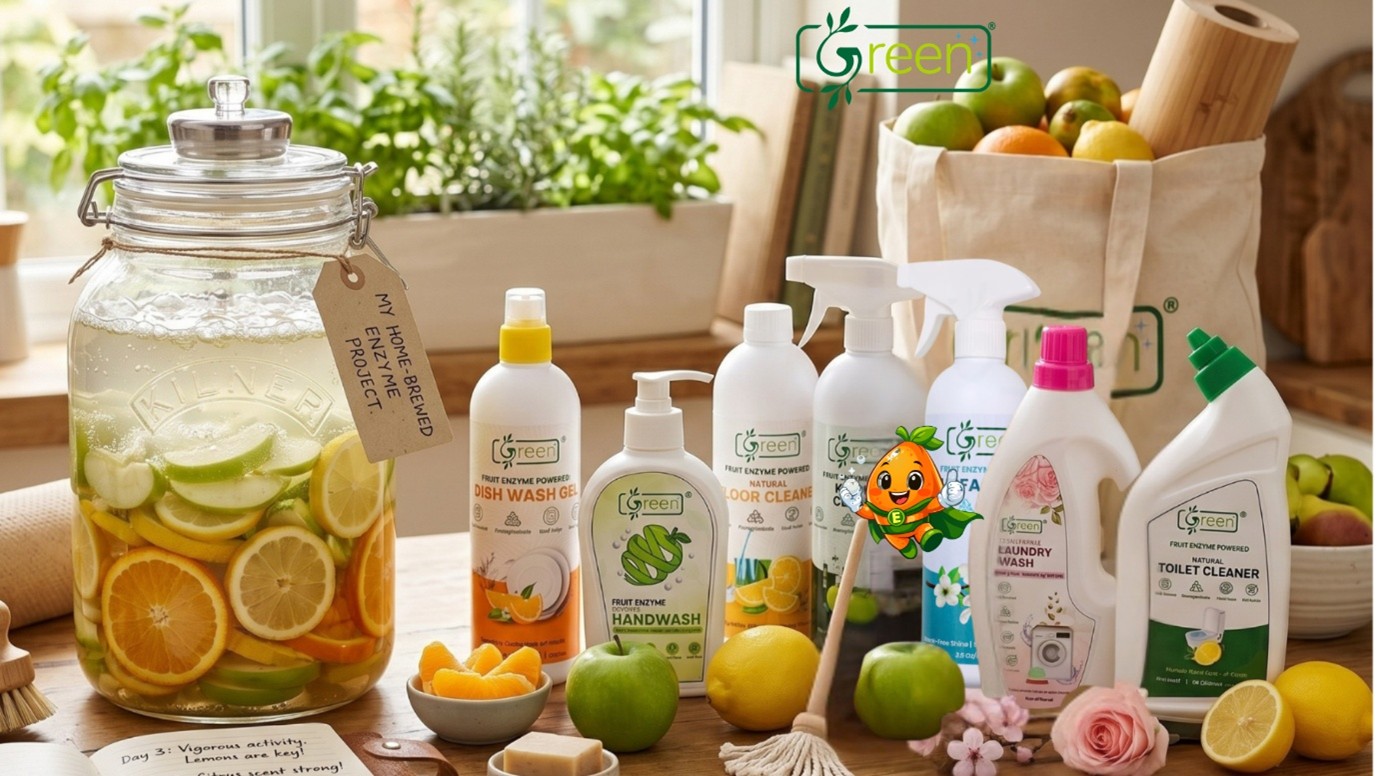
At Green Natural Products, we believe cleaning should not come at the cost of your health or the environment. As awareness grows, more people are switching to Eco-friendly cleaning products—but there’s still confusion around terms like “chemical-free,” “natural,” and “green.” [1]
Let’s break the myths—and introduce you to the next evolution in cleaning: fruit enzyme-based solutions.
Are “Chemical-Free” Cleaning Products Really Chemical-Free?
Let’s be clear: nothing is truly chemical-free. Even water is a chemical (H₂O).
When brands say “chemical-free,” they usually mean:
- Free from harsh or toxic chemicals
- No synthetic additives
- No harmful residues
At Green Natural Products, we focus on what truly matters:
Non-toxic, biodegradable, and plant-based formulations
The Problem with Conventional Cleaning Products
Many traditional cleaners rely on aggressive chemicals such as:
- Ammonia
- Chlorine bleach
- Synthetic fragrances
- Petrochemical-based surfactants
These can lead to:
- Skin irritation and allergies
- Respiratory issues
- Indoor air pollution
- Water contamination
Over time, these chemicals harm not just your home—but entire ecosystems.
What Makes Eco-Friendly Cleaning Products Better?
Eco-friendly products are designed to clean effectively without harming people or the planet.
Key Features of Our Approach:
- Plant-based ingredients
- Biodegradable formulas
- Non-toxic and skin-safe
- Environmentally responsible
- Safe for septic systems
The Power of Natural Ingredients in Cleaning
Nature already provides powerful cleaning agents:
- Citric Acid – Removes limescale and stains
- Vinegar – Cuts grease and neutralizes odors
- Baking Soda – Gentle scrubbing and deodorizing
- Fruit/Enzyme (Bio-Enzymes) – Break down organic waste naturally
Fruit Enzymes: The Next Level of Eco-Friendly Cleaning
This is where Green Natural Products stands apart.
What are Fruit-Enzymes?
Fruit-enzymes are natural solutions created by fermenting organic materials (Fruit peels a. They use beneficial microbes to break down dirt, grease, and waste at a molecular level. [2]
What Makes Fruit Enzymes Special?
Fruit enzyme cleaners are an advanced form of bio-enzymes, made using citrus peels and fruit extracts.
Why they are next-level eco-friendly:
- Derived from fruit waste (zero-waste concept)
- 100% biodegradable
- Non-toxic and residue-free
- Naturally antibacterial and deodorizing
- Continue working even after use (in drains & water systems)
Benefits of Switching to Green Natural Products
1. Healthier Home
No toxic fumes, no harmful residues—just clean, fresh spaces.
2. Safe for Kids & Pets
Gentle, plant-based formulas reduce risks.
3. Environmental Protection
Our enzyme-based cleaners reduce water pollution and support natural ecosystems.
4. Sustainable Living
We turn fruit waste into powerful cleaning solutions—closing the loop.
Common Myths About Eco-Friendly Cleaning
Myth 1: Natural products don’t work well
Truth: Enzyme-based cleaners often work better by breaking down dirt at the source.
Myth 2: They are expensive
Truth: Multi-purpose enzyme cleaners reduce the need for multiple products.
Myth 3: All green products are genuine
Truth: Many brands use “greenwashing”—always check ingredients.
How to Choose the Right Eco-Friendly Cleaning Product
Look for:
- Transparent ingredient lists
- Enzyme-based or plant-based formulas
- No artificial fragrance or dyes
- Biodegradable certifications
- Sustainable packaging
The Future of Cleaning is Enzyme-Based
The future is not just “natural”—it’s intelligent cleaning powered by nature.
Final Thoughts
“Chemical-free” may be a myth—but safe, non-toxic, and eco-friendly cleaning is very real.
By choosing enzyme-powered solutions, you’re not just cleaning your home—you’re:
- Protecting your family
- Reducing pollution
- Supporting a circular, sustainable future
References-
- Loux, R. (2008). Easy green living: the ultimate guide to simple, eco-friendly choices for you and your home. Rodale Books.
- Amish, N., Padmesh, T. N., & Kishanraj, S. (2026). Bio-enzymes in the Detergent Industry: A Pathway for Sustainable Entrepreneurship Through Waste Utilization. In Behavioral Economics and Computational Intelligence for Sustainable Decision Making: Integrating AI and Behavioral Insights to Drive Economic Efficiency and Sustainability (pp. 583-595). Cham: Springer Nature Switzerland.
